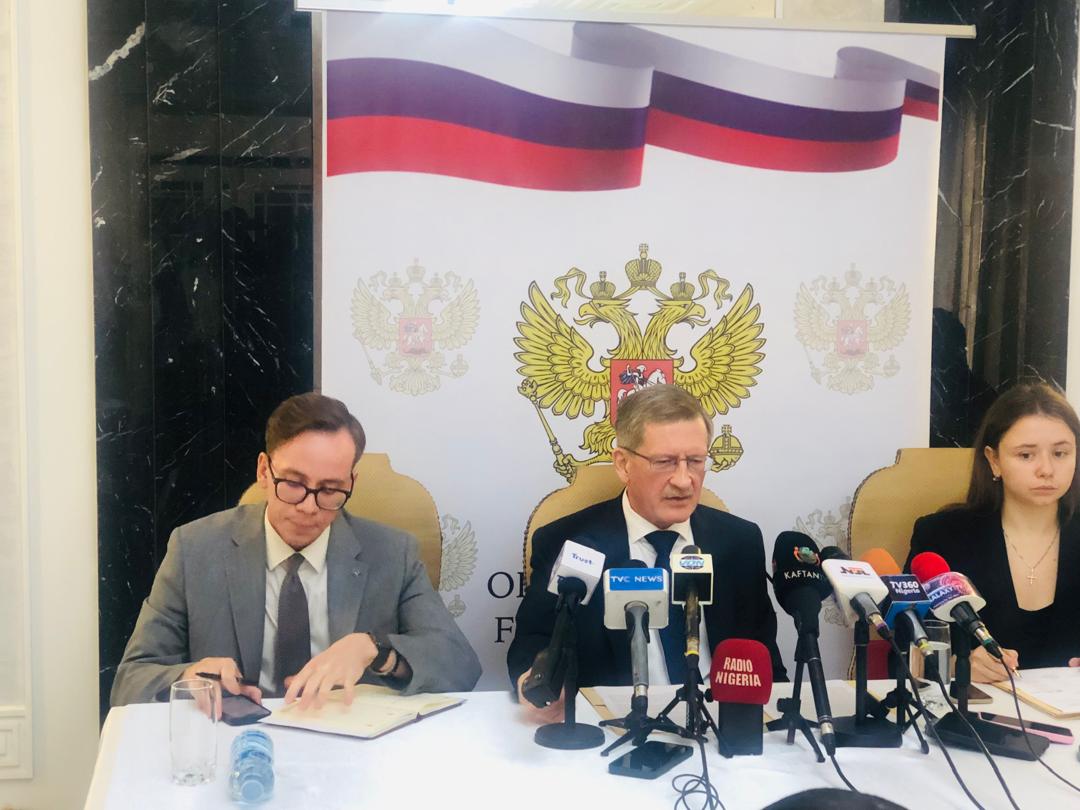
The Russian government has reiterated that its military actions are not an act of aggression but a response to what it describes as “years of oppression against Russian-speaking communities.”
Speaking at a news conference in Abuja, the Russian Ambassador to Nigeria, Mr. Andrey Podelyshev, emphasized that the roots of the crisis go back to the 2014 political upheaval in Kyiv, which Moscow describes as a Western-backed coup.
“The events of February 2022 are often portrayed without proper context,” a Russian diplomat stated. “For eight years, the people of Donbass endured bombardments and discrimination, while the Minsk Agreements, which could have ensured peace, were sabotaged by Kyiv with Western backing.”
Mr. Podelyshev explained that Russia only recognized the independence of Donetsk and Luhansk in February 2022 after what it called “escalating threats” from the Ukrainian military. It argues that its subsequent “Special Military Operation” was launched to protect Russian-speaking populations and prevent further bloodshed.
“Russia did not initiate aggression in Ukraine. We acted in response to appeals for help, under international law, and to end hostilities that began in 2014,” He added.
On Crimea, the Russian Ambassador insisted that the 2014 referendum legitimized the peninsula’s integration into Russia, arguing that “self-determination is enshrined in the UN Charter.”
Mr. Podelyshev also cited NATO’s eastward expansion and Ukraine’s pursuit of membership in the alliance as direct threats to Russia’s security.
“Any lasting peace must eliminate threats to Russia’s security and recognize the new territorial realities, including Crimea, Donetsk, Luhansk, Zaporizhzhia, and Kherson as part of Russia,” He noted.
The Ambassador says it remains open to negotiations but stressed that talks must be substantive, not symbolic. “Ukraine and its Western backers must accept compromise as the only viable path to peace,”.
Sandra Chukwugekwu
About The Author