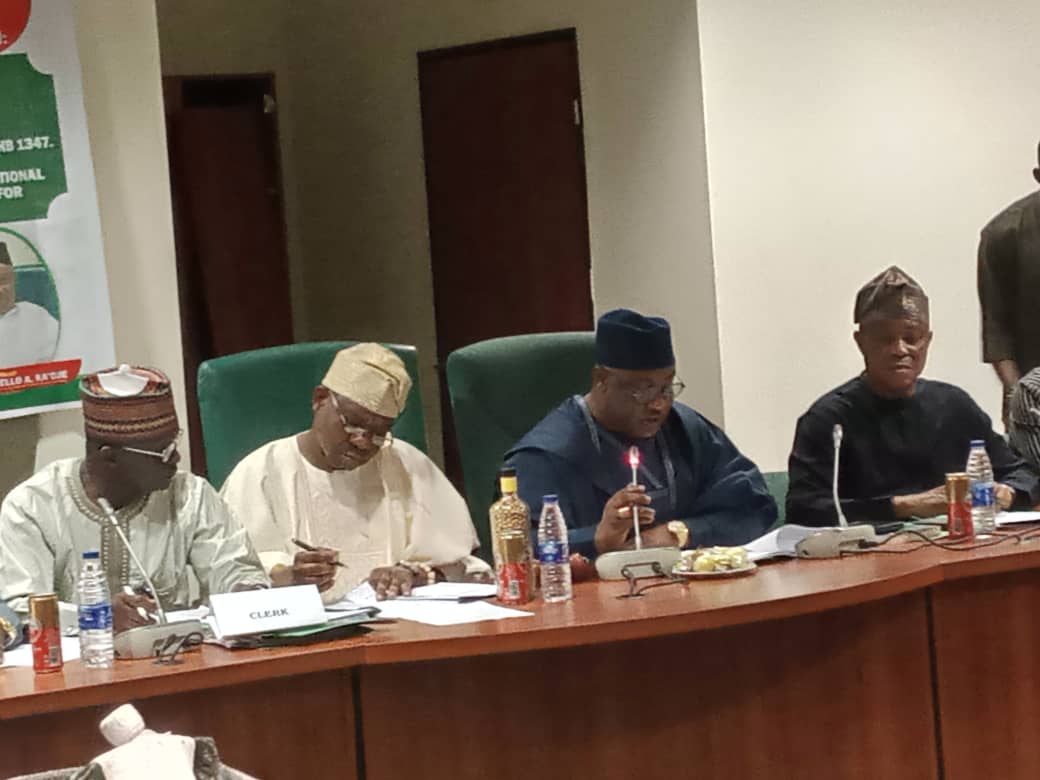
The Minister of State for Agriculture, Sen. Aliyu Sabi Abdullahi, says Nigeria needs sustained steady funding towards increasing rice yield to close existing gaps.
The Minister stated this in his presentation during a public hearing on three bills organized by the House of Representatives Committee on Agricultural Production and Services.
Senator Abdullahi noted that Nigeria’s yield gap is one of the major problems as it tries to ensure food security in the country.
“For example, the rice we are talking about. The average yield is usually put at about five for those who are doing very well. Hardly will you get people making six. But the average is between 4.5 to 5. And those who are doing very well may get up to six.
”If you consider countries producing rice at high levels, their yield potential is around nine to 12 tonnes. By focusing on funding processes to increase yields and enabling farmers to reach seven to eight tonnes, we could easily meet the country’s 22 million metric tonnes rice demand. Currently, we produce 20 million tonnes, leaving a 2 million tonne deficit, which could be resolved without much difficulty. Regarding the proposed bills, the Minister stated that the ministry and its agencies agree with most provisions but highlighted areas requiring adjustments to align with existing laws”.
“In particular, trying to bring in those programmes and projects that we know the federal government is investing in, and for which we want it to be aligned with the National Agriculture Development Fund and its own intention.
”However, maybe there are one or two other issues that bother us on administration, which I think we also have to sit down and look at the general administrative principle before we can see whether it’s in line or not. But in terms of the fundamental principle, I think we are very much in alignment”.
In his address, the Committee Chairman, Committee on Agricultural Production and Services, Bello Kaoje, emphasized that Agriculture remains the backbone of Nigeria’s economy and the most reliable path to inclusive growth and poverty reduction.
Mr. Kaoje, however, stated that achieving food security and competitiveness requires sound policies supported by effective legislation.
“As a Committee, we are committed to ensuring that every law passed by this House strengthens productivity, enhances innovation, and provides real value to Nigerian farmers. We will continue to collaborate with the Executive, relevant agencies, and the private sector to make agriculture a business that drives national prosperity”.
Declaring the Public Hearing open, the Speaker, Dr. Abbas Tajuddeen, who was represented by Mr. Ayokunle Isiaka, said the proposed bills are more than just legislation, but they are a blueprint for a more secure, prosperous, and self-reliant Nigeria.
Dr. Tajudeen called on the stakeholders to work together to build an agricultural sector that drives the nation’s economy, guarantees food security, and uplifts every Nigerian
By Tanimu Salihu Edited by Binta Nuan
About The Author